Every COO, VP of Engineering, and HR head hits the same wall eventually. The roadmap is approved, the budget is signed off, and the only thing standing between your company and shipped product is headcount you do not have. The instinct is almost always the same: post a few contractor roles, run them through the applicant tracking system, and plug the gaps one hire at a time.
That instinct is usually wrong, and it is expensive to find out why after the fact.
This is not a philosophical debate about outsourcing versus insourcing. It is a structural question about how work actually gets coordinated once you add people to a codebase, a sprint cycle, and a delivery commitment. The choice between individual contractors and a managed development team is a choice about where accountability lives, and that choice determines whether your scaling effort compounds your velocity or quietly taxes it.
The Real Problem: Coordination Overhead, Not Headcount
Most scaling decisions get framed as a cost question. What does it cost per hour for a contractor versus a dedicated team versus a full-time hire. That framing misses the actual failure mode.
When you add three isolated contractors to a product team, you are not adding three units of engineering capacity. You are adding three new communication nodes, three new sets of context that need to be built from scratch, three new relationships that a single engineering manager or product owner now has to maintain individually. The math is not additive, it is combinatorial. Every contractor you bolt onto a team without a shared operating structure multiplies the number of one-to-one relationships someone internally has to manage.
This is the core pain point behind nearly every failed staff augmentation engagement: adding isolated contractors increases coordination overhead and creates fragmented accountability. The contractor delivers their ticket. Nobody owns the integration. Nobody owns the handoff between the contractor’s work and the next sprint’s dependencies. When something breaks in production three weeks later, there is no single point of accountability, just a chain of “that was not my scope.”
This is why organizations that start with individual contractor hiring to save money on paper often end up spending more in engineering management time, QA rework, and delayed releases. The direct hourly rate was never the real cost driver. The coordination tax was.
What a Software Development Pod Actually Is
A software development pod, sometimes called an engineering pod, is a small, cross-functional, self-contained unit that owns a specific product outcome end to end. A typical pod includes a mix of backend and frontend engineers, a QA specialist, and often a technical lead or delivery manager who sits between your internal product owner and the pod’s day-to-day execution.
The defining feature of an engineering pod is not team size. It is unified accountability. The pod is measured on outcomes, not hours logged. If a feature ships broken, the pod owns the fix. If a sprint commitment slips, the pod’s lead answers for it, not five different contractors pointing at each other.
This is the structural difference that matters for anyone comparing contractors vs dedicated team models. A contractor’s contract typically defines hours or deliverables at the task level. A pod’s engagement defines outcomes at the product level. That distinction changes everything about how much internal management overhead you carry.
Core Components of a Managed Development Team
A properly built managed development team includes a few non-negotiable elements:
1. A single point of contact who owns delivery accountability, not just task assignment.
2. Cross-functional skill coverage so the team does not stall waiting on an external specialist.
3. Established internal processes for code review, QA, and release management that do not depend on your internal team re-explaining standards every sprint.
4. Continuity of institutional knowledge, meaning the same people stay on your codebase across quarters rather than rotating out every few months.
5. A vendor or partner organization that carries the HR, compliance, and bench management burden, so you are not managing individual employment relationships.
If any one of these is missing, what you have purchased is not a managed team. It is a group of contractors with a shared invoice, and you will absorb the coordination cost regardless of what the vendor calls it.
Engineering Pods vs. Individual Contractors: A Direct Comparison
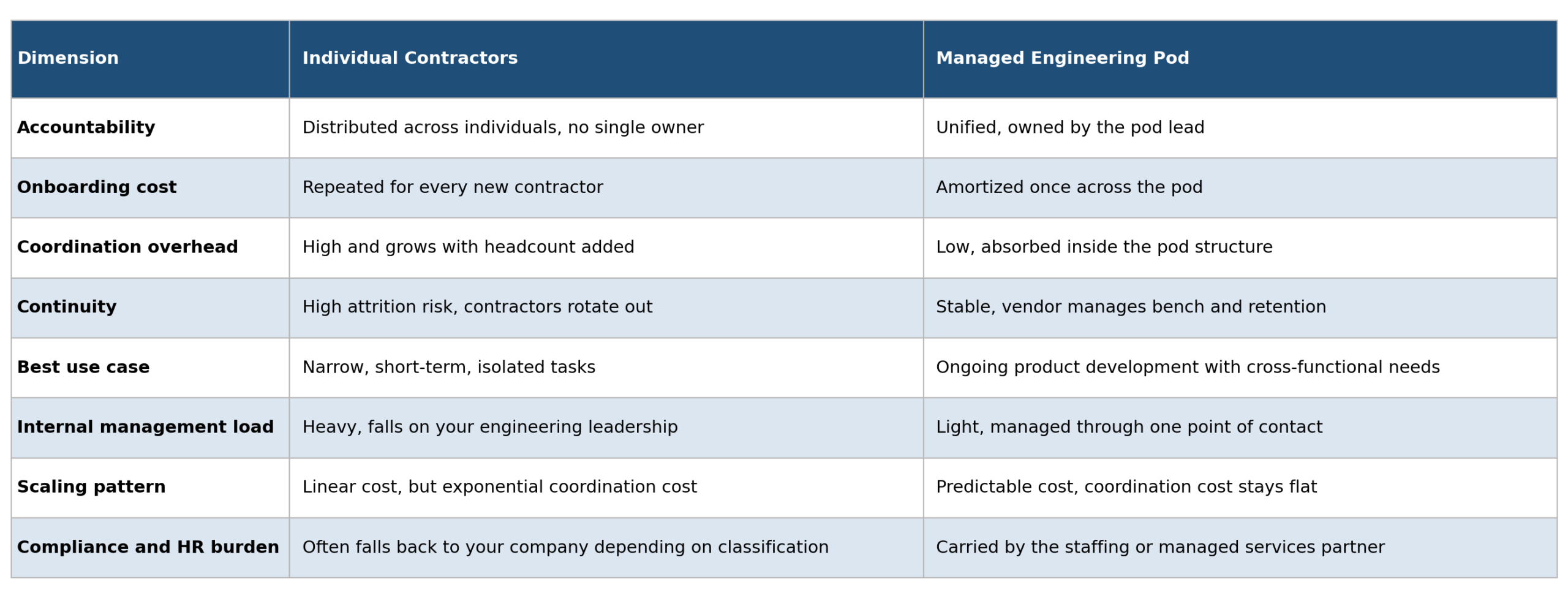
This table is the shortcut version of the argument, but the line that matters most for a COO evaluating a scaling decision is the coordination row. Cost per hour is visible on an invoice. Coordination overhead is invisible until it shows up as missed deadlines, and by then it has already cost more than the rate difference would have.
Why Fragmented Accountability Is the Silent Budget Killer
HR heads and COOs evaluating IT staff augmentation options tend to run the numbers on hourly rate comparisons between contractor markets. That comparison is necessary but insufficient. It answers what the labor costs. It does not answer what the fragmentation costs.
Fragmented accountability shows up in three measurable ways inside real engineering organizations:
Rework and defect rates climb.
When five contractors each own a slice of a feature with no unified QA process, integration bugs surface late, often in staging or production, where they are far more expensive to fix than they would have been inside a pod’s internal review cycle.
Delivery timelines become unpredictable.
A single contractor going on leave, exiting the engagement, or simply being slow to respond to a Slack message becomes a project-level risk when there is no redundancy built into the structure. A pod is built with cross-coverage in mind. A collection of individual contractors is not.
Institutional knowledge walks out the door.
Contractors, by design, are transient. When a contractor’s engagement ends, whatever undocumented context they carried about your codebase leaves with them. A managed team, especially one run through a staffing partner with retention incentives, is structured to keep that knowledge inside the team over multiple release cycles.
None of this shows up on a rate card. It shows up in a missed board deadline, a customer-facing bug that should have been caught in review, or a hiring manager’s calendar that is suddenly full of status-check meetings instead of strategic work.
Contractors vs. Dedicated Team: What Changes at Scale
A single contractor is manageable. Two contractors is still manageable if your engineering manager has time. The failure point tends to appear at three to five isolated contractors working on interdependent parts of the same product, which is precisely the headcount range many growth-stage companies hit when trying to accelerate a roadmap.
A dedicated development team model changes the shape of that scaling curve. Instead of your internal engineering manager coordinating five separate relationships, they coordinate one relationship with a pod lead who is internally coordinating the five engineers. The complexity does not disappear, it moves to where it can be managed efficiently, inside a structure that is built for it.
This is the single clearest argument for choosing a dedicated team model over contractor accumulation once you are scaling past a proof of concept into sustained product development: the coordination complexity of a growing team should be absorbed by a management layer designed for it, not distributed across contractors with no shared operating structure and no single point of accountability.
Why AI-Assisted Software Development Strengthens the Case for Engineering Pods
AI coding tools have increased the output potential of individual developers.
Microsoft researchers studied 4,867 developers across Microsoft, Accenture, and another Fortune 100 company. Developers with access to AI coding assistance completed approximately 26% more tasks in the combined analysis.
That result is significant, but executives should not interpret it as proof that companies only need more AI-enabled contractors.
AI accelerates coding. It does not automatically improve product decisions, architecture, integration, security, testing, observability, or release governance.
DORA’s 2025 research concluded that AI acts as an amplifier. It magnifies the strengths of high-performing organizations and the dysfunctions of poorly structured ones.
This has direct implications for contractors vs. dedicated teams.
An isolated AI-enabled contractor may produce code faster, but the organization must still:
- Validate the code
- Review security implications
- Confirm architectural fit
- Test integrations
- Maintain documentation
- Monitor production behavior
- Handle technical debt
- Align implementation with customer requirements
A cross-functional engineering pod can absorb AI-generated speed across the delivery lifecycle.
Developers use AI for implementation. QA uses it to expand test coverage. DevOps uses automation for infrastructure and incident analysis. Technical leads establish standards for approved models, code review, security, and intellectual property protection.
Perforce’s 2026 platform engineering research surveyed 820 technology professionals. It found that 73% of organizations with mature platform engineering practices considered platform maturity a critical or significant factor in AI success, compared with 44% of less mature organizations.
The conclusion is straightforward:
AI makes disciplined team structure more valuable because code generation is no longer the primary constraint. Coordination, verification, architecture, and operational control become the constraints.
Nearshore and Offshore Considerations for Pod-Based Scaling
Geography matters more for pod-based engagement models than it does for isolated contractor hiring, because a pod’s internal coordination depends on overlapping working hours and consistent communication cadence.
Nearshore software development, engaging teams in geographies with close time zone alignment, tends to outperform pure offshore models for pod structures specifically because the pod’s internal standups, code reviews, and product syncs need to happen in near real time with your internal stakeholders. Offshore engagements with minimal time zone overlap can still work for pods, but they require more deliberate handoff documentation and asynchronous process discipline to avoid recreating the same coordination gap the pod model was meant to solve.
The practical guidance for a COO comparing options: if your product requires frequent, fast-turnaround collaboration between your internal product team and the engineering pod, prioritize time zone overlap over marginal rate savings. If the work is more modular and can tolerate asynchronous handoffs, a wider geographic net for talent sourcing becomes viable without sacrificing delivery quality.
How to Structure a High-Performing Software Development Pod
Simply placing several professionals under one contract does not create a pod.
A high-performing software development pod needs five design elements.
1. A Clear Product or Capability Boundary
The pod should own a specific area.
Examples include:
- Customer onboarding
- Payment processing
- Reporting and analytics
- Mobile application development
- Cloud modernization
- AI workflow automation
- Internal operations platform
Avoid defining the pod as “five developers.” Define it by the business or product capability it is expected to improve.
2. Cross-Functional Composition
The pod should contain enough capability to move work through the lifecycle.
A standard pod may include:
- One technical lead
- Two to five software engineers
- One QA automation engineer
- Shared DevOps support
- Product ownership or business analysis
- UI and UX support as needed
The exact team depends on the product. A data platform pod will look different from a mobile product pod.
3. Defined Decision Rights
The organization must clarify who decides:
- Product priority
- Architecture
- Technology standards
- Release timing
- Security exceptions
- Budget tradeoffs
- Scope changes
Without defined decision rights, even a well-staffed pod will wait for approvals.
4. Outcome-Based Metrics
Do not measure the pod using hours worked or lines of code.
Microsoft’s 2026 EngThrive framework organizes engineering productivity around speed, ease, quality, and developer thriving. It was created to help organizations move beyond activity metrics toward measurable system-level outcomes.
Useful pod metrics include:
- Lead time for changes
- Deployment frequency
- Change failure rate
- Mean time to recovery
- Escaped defects
- Sprint goal success
- Product adoption
- Customer satisfaction
- Reliability
- Time from idea to production
- Cost per product increment
- Technical debt reduction
The metrics should connect engineering performance with business value.
5. Integrated Governance
The pod should operate independently within defined guardrails.
Governance may include:
- Architecture standards
- Secure coding policies
- AI tool usage policies
- Code review requirements
- Test coverage expectations
- CI/CD controls
- Access controls
- Documentation requirements
- Observability standards
- Release approval thresholds
The objective is not to micromanage the pod. It is to make the safe and compliant path the default path.
How BorderlessMind Helps Companies Build Managed Engineering Pods
BorderlessMind helps organizations move beyond disconnected technical hiring and build product-aligned engineering capacity.
The process begins by identifying the delivery problem, not merely collecting job descriptions. BorderlessMind evaluates the product roadmap, internal leadership capacity, technical environment, capability gaps, time-zone requirements, and expected outcomes.
Based on those requirements, organizations can build a dedicated software development pod that may include software engineers, QA automation, DevOps, product support, data specialists, AI engineers, and technical leadership.
The goal is to provide a managed development team that operates as an extension of the client organization while maintaining clear accountability, communication, quality controls, and delivery visibility.
BorderlessMind can also support organizations that do not need a complete pod. When a mature internal team only needs a specific capability, targeted staff augmentation or fractional talent may be the better model.
The decision is based on the actual operating need:
- Individual specialist for a contained gapNe
- Staff augmentation for internally managed capacity
- Fractional leadership for strategic or technical direction
- Managed engineering pod for cross-functional product delivery
- Dedicated offshore team for long-term scalable capacity
Frequently Asked Questions
Q. What is the difference between an engineering pod and a dedicated development team?
The terms are largely interchangeable in practice. Both describe a cross-functional, self-contained team unit assigned to a specific product or workstream, with a shared management structure that owns delivery outcomes rather than individual task completion.
Q. Is staff augmentation cheaper than a managed pod model?
The headline hourly rate is often lower for staff augmentation because it excludes a management layer. Once you account for the internal management time required to coordinate multiple individual contractors, the total cost frequently favors a managed pod, particularly for engagements longer than one quarter.
Q. When should a company use individual contractors instead of a pod?
Individual contractors work well for narrow, well-defined, short-duration tasks with minimal cross-team dependency, and where internal engineering management has the bandwidth to directly supervise the work.
Q. What is the biggest risk of scaling with isolated contractors?
Fragmented accountability. As you add contractors without a shared operating structure, no single person owns integration, quality, or delivery timelines, which increases rework and unpredictability as headcount grows.
Q. Does nearshore software development work well for engineering pods?
Yes, and generally better than offshore models with minimal time zone overlap, because pod-based work depends on frequent real-time collaboration between the pod and internal stakeholders.
Q. What is the classification risk with long-term contractors?
Contractors engaged on a long-term, exclusive, closely supervised basis can resemble employees under labor law, exposing the hiring company to misclassification penalties. A managed pod model shifts this compliance burden to the partner organization that directly employs the engineers.
Where ISHIR Fits
ISHIR builds and manages engineering pods for companies that need product development capacity without inheriting the coordination overhead of contractor accumulation. Every pod comes with a single point of accountability, cross-functional skill coverage, and a delivery structure built to integrate directly with your existing product and engineering leadership.
If your team is evaluating how to scale product development without turning your engineering managers into full-time contractor coordinators, that is a conversation worth having before the next hiring cycle, not after the next missed deadline.
0 Comments


 Prarthana Bhatia
Sep 11, 2026
Prarthana Bhatia
Sep 11, 2026











 Schedule a Call