The global competition for IT talent is no longer about who can post jobs faster. It’s about who can make smarter hiring decisions. AI agents are steadily removing the bottlenecks that have slowed recruitment for years, and the organizations adopting them now are likely to shape how hiring works over the next five years.

The Recruitment Challenge in IT
Ask any engineering manager in 2026 what keeps them up at night, and hiring is almost always near the top of the list. Demand for software engineers, AI and ML specialists, cloud architects, and cybersecurity professionals has been higher than supply for a long time. At the same time, many hiring teams still rely on outdated tools like spreadsheets, long email threads, and disconnected ATS platforms that create more problems than they solve.
The issue is not just about volume. Recruiters receive a flood of applications from candidates who are not a strong match, while highly qualified candidates often get overlooked. Manual screening takes time, varies in quality, and can be influenced by unconscious bias. The system has needed a better approach, and AI agents are starting to provide that shift.
What Is an AI Recruiting Agent?
An AI recruiting agent goes beyond simple automation or keyword matching. It is designed to think, adapt, and handle multiple steps across the hiring process. Instead of just filtering resumes, it can source candidates, understand context, schedule conversations, evaluate fit using different signals, and improve over time based on feedback.
A simple way to think about it is this: it works like a highly efficient junior recruiter who never forgets details, never has scheduling conflicts, and can manage multiple roles at once without getting overwhelmed.
Where AI Agents Are Making an Impact
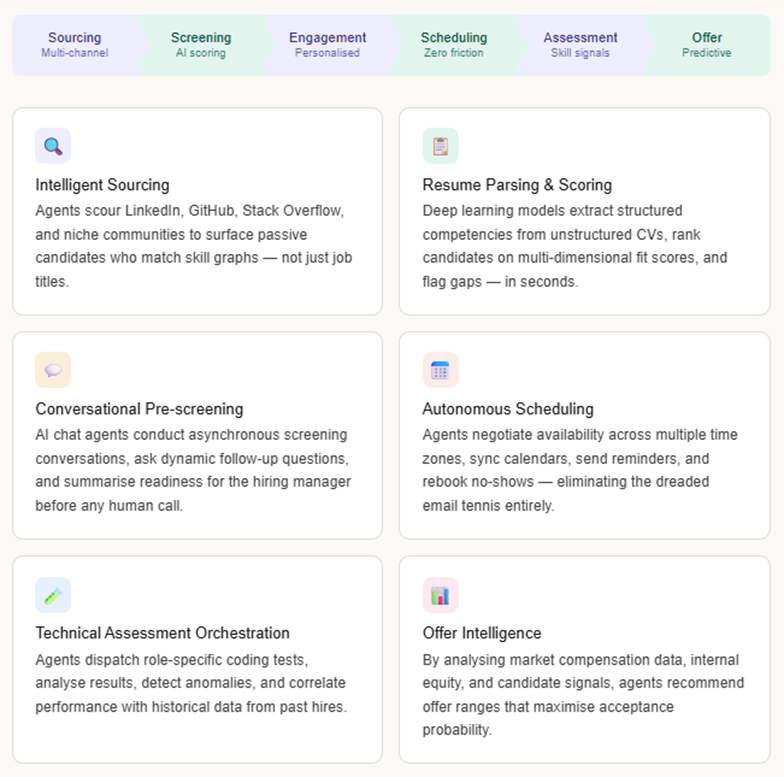
AI agents are already reshaping different stages of the hiring funnel, helping teams move faster and make more consistent decisions.
Scaling Without Losing the Human Element
One of the biggest misconceptions is that AI will replace human judgment in recruitment. In reality, it supports it. AI agents take over repetitive, data-heavy tasks, allowing recruiters to focus on what matters most: building relationships, understanding cultural fit, and identifying potential beyond what’s written on a resume.
Many IT companies in 2026 are using what’s now called a hybrid recruiting model. In this setup, one experienced talent partner works alongside several AI agents. Together, they manage a workload that would previously require a much larger team. Some organizations report handling up to three times more roles without increasing headcount, while also improving the candidate experience.
Industry Perspective
Talent acquisition leaders across mid and large tech companies are seeing a clear shift. Their teams are spending more time on strategic priorities like employer branding, diversity initiatives, and workforce planning. At the same time, routine administrative work has reduced significantly. AI does not replace strategy; it creates more space for it.
What Strong Implementation Looks Like
Successful AI recruiting setups tend to follow a few common principles. They integrate with existing ATS systems rather than replacing them, adding intelligence on top of current workflows. They also include clear safeguards to reduce bias, with regular checks to ensure fair outcomes across different candidate groups.
Transparency is another key factor. Candidates should know when they are interacting with AI and should always have the option to connect with a human.
The most advanced teams also use feedback loops. For example, if a candidate performs exceptionally well after being hired, that information is fed back into the system. Over time, this helps improve how candidates are evaluated and selected.
Challenges to Keep in Mind
- Bias risks: AI trained on past data can carry forward existing biases. Regular audits and diverse datasets are essential.
- Candidate experience: Too much automation can feel impersonal. The goal should be to personalize interactions, not remove the human touch.
- Integration issues: Older systems and fragmented data can slow things down. A phased approach often works better than trying to change everything at once.
- Compliance requirements: Regulations like GDPR and India’s DPDP Act require careful handling of data, clear consent, and explainable decision-making.
- Over-reliance on AI: AI should support decisions, not make them entirely. Human oversight remains critical.
The Road Ahead: What’s Coming Next
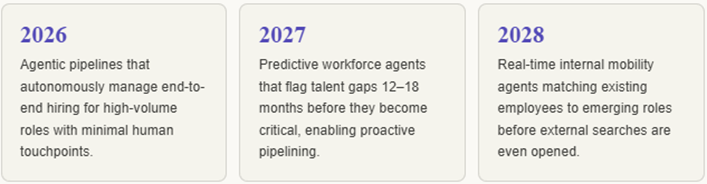
What Should IT Leaders Do Now?
If your organization is still deciding whether to invest in AI for recruitment, the market has already made that decision clear. The real question is where to begin and how quickly to move.
The most successful teams did not wait for perfect solutions. They started with one part of the hiring process that caused the most friction, such as resume screening or interview scheduling. They measured results carefully and then expanded step by step.
A good starting point is to review your current hiring process. Identify where the most time is spent and where outcomes are inconsistent. That is where an AI agent can add immediate value.
Build gradually, keep people at the center of decision-making, and treat your AI systems as something that improves over time with every hire.
0 Comments


 Prarthana Bhatia
Sep 11, 2026
Prarthana Bhatia
Sep 11, 2026










 Schedule a Call