Your enterprise customer wants a SOC 2 Type II report before signing a six-figure contract. Your sales team has committed to a deadline. Your CTO says the infrastructure is secure. Your compliance consultant has a checklist ready.
But there is one uncomfortable question nobody has answered.
Who is actually responsible for making sure your security controls work, your evidence is audit-ready, and your business can survive the auditor’s scrutiny?
This is where many SaaS companies get stuck. They invest in compliance software, hire consultants, write security policies, and discover months later that nobody owns the actual security program.
If your SOC 2 audit is six months away, your most important hiring decision may not be which compliance consultant to engage. It may be whether you need a fractional CISO for SOC 2 compliance who can take responsibility for security strategy, control implementation, and audit readiness.
But a fractional CISO is not always the answer. Sometimes a GRC specialist is sufficient. Sometimes you need both. And you will still need an independent CPA firm to issue the SOC 2 report.
Let’s examine the difference, when to hire each professional, and how to make the right decision before your audit deadline becomes a business problem.
Can a Fractional CISO Help Your SaaS Startup Prepare for SOC 2 Type II?
Yes. A fractional Chief Information Security Officer (CISO) can lead SOC 2 readiness, establish security governance, assign control ownership, coordinate remediation, and prepare internal teams for an independent SOC 2 examination. However, a fractional CISO cannot independently issue the SOC 2 report or guarantee an unqualified audit opinion.
For US SaaS startups without a full-time security executive, hiring an experienced fractional CISO can provide the leadership needed to move from scattered security activities to a coordinated, evidence-backed security program.
The key distinction is accountability. A compliance consultant may help identify what evidence is required. A fractional CISO should help ensure that the right controls exist, operate effectively, and have accountable owners.
However, neither professional can replace operational work by engineering, HR, IT, or other teams. Company management remains responsible for its systems, controls, and assertions.
The Real SOC 2 Problem Isn’t Missing Documentation. It’s Missing Ownership.
Consider a hypothetical 60-person B2B SaaS company preparing for its first SOC 2 Type II report.
Its CTO manages AWS infrastructure, a DevOps engineer handles access permissions, HR maintains employee onboarding records, and an external consultant has drafted the security policies.
Everything appears organized until the readiness assessment begins.
The access review policy exists, but nobody has documented quarterly reviews. The incident response plan looks professional, but nobody has tested it. Vendor risk assessments are incomplete. Security awareness training records are scattered across systems. Critical vulnerabilities have been detected, but remediation decisions are not consistently documented.
The company has security tools, security policies, and capable engineers.
What it lacks is someone responsible for ensuring these components operate as a functioning security program.
SOC 2 Type II examines whether relevant controls operated effectively over a defined period, not merely whether policies exist.
That difference is important. A company cannot reliably make up months of missing access reviews or incident response evidence when the auditor asks for it.
The American Institute of Certified Public Accountants (AICPA) organizes SOC 2 examinations around Trust Services Criteria covering security, availability, processing integrity, confidentiality, and privacy. Security is included in SOC 2 examinations, with additional categories selected according to the engagement’s scope and applicable commitments.
A company’s objective should therefore be to build a defensible control environment, not simply complete a checklist.
Fractional CISO vs. Compliance Consultant vs. GRC Specialist: Who Should You Hire?
When Should You Hire a Fractional CISO?
Hire a fractional CISO when your organization lacks executive-level cybersecurity leadership and needs someone to connect compliance requirements with actual business and technical risks.
This is particularly relevant when your CTO is already overloaded, security decisions are spread across teams, or nobody has the authority to enforce remediation priorities.
A qualified fractional CISO should be able to assess the current security program, establish risk priorities, secure management alignment, and oversee a practical plan for achieving audit readiness.
When Is a Compliance Consultant or GRC Specialist Enough?
A compliance consultant may be sufficient when your SaaS company already has mature security controls, an accountable security leader, and well-defined internal processes.
In this situation, your primary challenge may be organizing evidence, mapping controls against the Trust Services Criteria, preparing audit documentation, or coordinating requests with the independent auditor.
A skilled GRC specialist can be extremely valuable for these activities. Hiring an executive-level CISO simply to collect screenshots, maintain spreadsheets, and upload evidence would be an inefficient use of resources.
When Do You Need Both?
You may need a fractional CISO and a GRC specialist when your company has substantial security gaps, a demanding audit timeline, and limited internal bandwidth.
The fractional CISO leads the security program, prioritizes risk, and establishes accountability. The GRC specialist handles much of the control mapping, evidence coordination, documentation, and audit workflow.
Your engineering and business teams implement and operate the controls. An independent CPA firm then performs the examination.
The right question is not which job title sounds more senior. It is which responsibilities your existing organization cannot reliably fulfill.
SOC 2 Type I vs. Type II: Why Your Six-Month Deadline May Already Be at Risk
One of the biggest mistakes SaaS hiring managers make is treating SOC 2 as a short-term documentation project.
SOC 2 Type I and Type II reports evaluate different things.
A Type I report examines the suitability of control design at a specific point in time. A Type II report additionally examines whether those controls operated effectively over a defined period.
The AICPA does not prescribe one universal minimum Type II observation period. First-time examinations sometimes use a three-month period, while six- and twelve-month reporting periods are common. The appropriate period should be agreed upon with the independent auditor and considered against customer requirements.
For example, if your enterprise customer expects six months of operating evidence, you cannot replace that requirement with three months of documentation simply because your deadline is approaching.
You must also account for readiness work, remediation, audit fieldwork, and report issuance.
Industry guidance commonly places first-time SOC 2 Type II efforts in a range of roughly six to twelve months or longer, depending on current maturity, scope, and the reporting period.
This leads to an important distinction:
Having six months until your audit begins is not the same as having six months until your customer needs the final report.
Before hiring anyone, confirm the exact deadline, report type, required observation period, and whether the customer will accept interim assurance documentation.
If the deadline is genuinely six months away and your organization has not implemented basic controls, a full Type II report may not be realistic within that window.
A fractional CISO’s value includes recognizing that problem early and helping management make a credible plan instead of promising an impossible timeline.
What Should a Fractional CISO Do in the First Six Months of SOC 2 Preparation?
A strong fractional CISO should deliver a measurable readiness program rather than a collection of policies and recommendations.
The following roadmap is an illustrative six-month plan for a SaaS company whose initial controls already exist or can be implemented quickly. It does not guarantee that the final Type II report will be issued within six months.
Month 1: Identify Security Gaps Before the Auditor Finds Them
The first priority is understanding the organization’s security posture.
The fractional CISO should examine infrastructure, identity and access management, employee onboarding and termination processes, vendor dependencies, change management, vulnerability handling, incident response, and existing security documentation.
The company should also confirm the systems, services, locations, and Trust Services Criteria included in the proposed audit scope.
By the end of the month, management should have a documented risk assessment, a prioritized remediation backlog, a control ownership matrix, and a realistic examination timeline agreed upon with the auditor.
Expected deliverable: SOC 2 readiness assessment, defined audit scope, assigned control owners, and an approved remediation roadmap.
Month 2: Fix the Controls That Could Derail the Audit
This is where leadership matters more than documentation.
If terminated employees retain access, critical vulnerabilities remain unresolved, or production changes lack approvals, someone must ensure those gaps are corrected.
The fractional CISO should coordinate with engineering, IT, HR, and business leadership to establish repeatable processes rather than temporary workarounds.
Important activities may include strengthening multifactor authentication, formalizing access reviews, documenting change approvals, validating backup restoration procedures, and establishing an actionable incident response plan.
Expected deliverable: Implemented or remediated priority controls, documented procedures, and evidence collection responsibilities.
Month 3: Establish a Reliable Evidence Collection Process
Having a control is not enough. Your organization must be able to demonstrate that it operated as intended during the period covered by the examination.
The fractional CISO and GRC specialist should establish evidence repositories, recurring review schedules, access permissions, and procedures for documenting exceptions.
Evidence may include access review records, employee training completion, vulnerability scan reports, vendor assessments, incident response exercise results, change approval histories, and security monitoring records.
Evidence should be collected from actual operational systems where practical. Reports and screenshots should have reliable timestamps, traceable origins, and appropriate access controls.
Expected deliverable: A working evidence collection system with an accountable owner for each applicable control.
Month 4: Test Control Effectiveness and Resolve Exceptions
The next step is determining whether the controls actually work.
For example, if policy requires quarterly access reviews, verify that the reviews were performed and documented. If incident response procedures require escalation, conduct a tabletop exercise and retain the relevant records.
Where deficiencies are discovered, the team should document root causes, corrective actions, responsible owners, and remediation dates.
The fractional CISO should distinguish between isolated process errors and systemic weaknesses that could affect the examination.
Expected deliverable: Internal control testing results, exception register, and remediation progress report.
Month 5: Prepare for Auditor Requests and Security Due Diligence
Before formal examination fieldwork, the internal team should be able to explain the system, describe relevant controls, identify their owners, and retrieve supporting evidence.
The fractional CISO should review documentation quality and assess whether internal stakeholders understand their responsibilities during auditor interviews.
This is also an opportunity to align SOC 2 readiness with enterprise customer security questionnaires and procurement requirements.
The objective is not to coach employees into giving artificial answers. It is to ensure that security practices are understood, consistently followed, and accurately represented.
Expected deliverable: Reviewed evidence inventory, documented open issues, and management-approved audit readiness status.
Month 6: Support the Examination and Establish Ongoing Governance
If the agreed observation period has ended and required evidence is available, the independent auditor can complete the applicable testing and reporting procedures.
The fractional CISO should coordinate timely management responses, help teams investigate identified exceptions, and ensure that requested evidence is accurate and complete.
If the observation period remains open, evidence collection and control operation continue. The audit calendar must reflect the actual reporting period rather than an arbitrary six-month project deadline.
Expected deliverable: Examination support and a documented governance plan for continued security operations, remediation, and subsequent audit cycles.
The biggest benefit of this approach is that security accountability does not disappear once the initial SOC 2 report is issued.
The SOC 2 Evidence Checklist Your Fractional CISO Should Understand
Before hiring a fractional CISO, ask how they would organize evidence across the areas relevant to your audit scope.
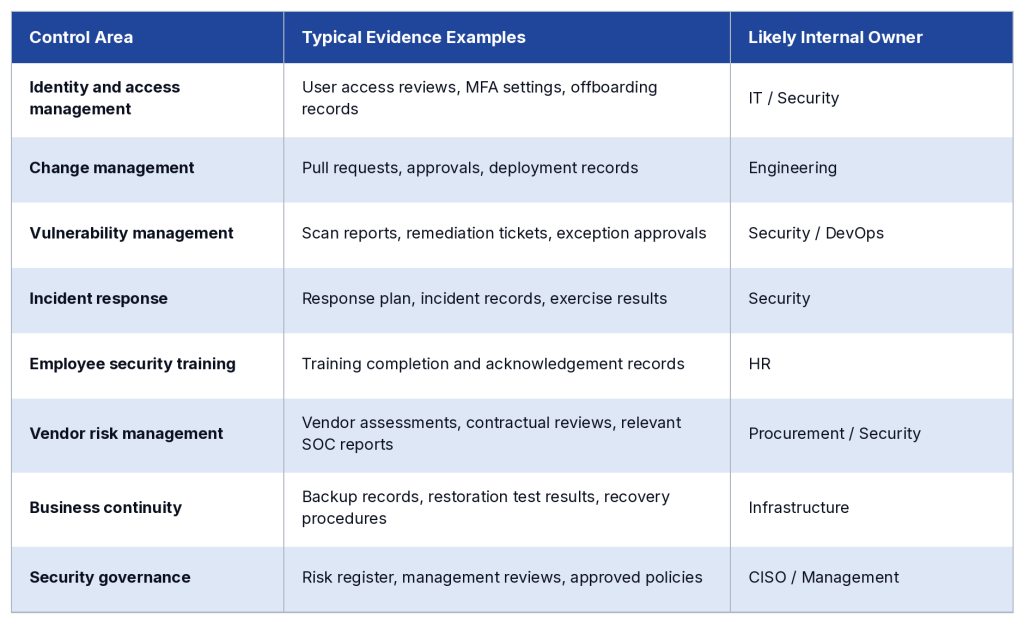
These are illustrative examples, not a universal list of mandatory SOC 2 artifacts. The exact evidence requirements depend on the controls, system description, examination scope, and auditor’s procedures.
A qualified fractional CISO should understand this distinction and avoid treating a generic template as the final authority.
How to Hire a Fractional CISO for SOC 2 Compliance: A Practical Guide for US Recruiters
Hiring a fractional CISO is different from recruiting a security engineer or a compliance coordinator.
A strong candidate must understand technical controls, governance, executive reporting, and the practical requirements of independent assurance examinations.
That combination is not guaranteed by a senior job title or a long list of certifications.
Step 1: Define the Actual SOC 2 Hiring Requirement
Before sourcing candidates, determine whether your company needs an executive security leader, hands-on GRC support, or a hybrid professional.
Document your current security maturity, audit deadline, report type, technical environment, and existing internal resources.
For example, a 40-person SaaS startup with a single cloud environment and no security leader may need a different engagement than a 300-person company with an established security team preparing for its fourth annual SOC 2 report.
Recruiter takeaway: Build the job description around measurable business deliverables, not generic cybersecurity responsibilities.
Step 2: Prioritize Demonstrated SOC 2 Type II Experience
Ask candidates about examinations they have helped organizations prepare for, including the scope, reporting period, control deficiencies, and their specific responsibilities.
A candidate who has participated in an audit is not necessarily someone who has led a readiness program.
Look for professionals who can explain how they established control ownership, resolved security gaps, handled difficult auditor questions, and worked with technical and nontechnical stakeholders.
Recruiter takeaway: Ask for evidence of previous leadership responsibility, not confidential reports belonging to former clients.
Step 3: Evaluate Technical and Governance Expertise Together
Relevant credentials may include CISSP, CISM, CISA, CRISC, or comparable experience. Certifications can support candidate evaluation, but should not substitute for demonstrated practical skills.
The candidate should be comfortable discussing cloud security, identity management, vulnerability management, incident response, risk assessment, security policies, and GRC processes.
For a cloud-native SaaS business, experience with AWS, Azure, Google Cloud, or its specific operating environment may be especially valuable.
Recruiter takeaway: A candidate who understands compliance terminology but cannot engage credibly with your engineering team may struggle to lead technical remediation.
Step 4: Ask These Seven Fractional CISO Interview Questions
1. Our SOC 2 Type II report is due in six months, but we have never completed a formal readiness assessment. What would you do in your first two weeks?
Look for a realistic assessment of current controls, auditor availability, scope, observation periods, and deadline risk.
2. How would you determine whether we need a fractional CISO, a GRC specialist, or both?
Strong candidates should distinguish executive security accountability from evidence administration.
3. What happens if we discover that quarterly access reviews were not performed during the reporting period?
A credible candidate should discuss transparency, remediation, the auditor’s evaluation, and avoiding fabricated evidence.
4. How would you divide SOC 2 responsibilities among engineering, HR, IT, and executive management?
Look for a clear control ownership model and realistic internal resource requirements.
5. Which SOC 2 controls would you prioritize for a SaaS company running customer-facing applications on AWS?
Strong candidates should first assess the company’s risks and commitments rather than assuming one universal checklist.
6. How would you explain a serious compliance gap to our CEO and an enterprise customer?
Evaluate judgment, communication, accuracy, and the ability to explain business implications without exaggeration.
7. What measurable outcomes should we expect after 30, 60, and 90 days?
Expect specific deliverables, evidence of progress, assigned responsibilities, and risk reduction indicators.
Step 5: Watch for These Fractional CISO Hiring Red Flags
A candidate who promises a guaranteed SOC 2 Type II report in 30 days without examining your existing controls should raise concerns.
Other warning signs include treating SOC 2 as a certification, confusing readiness consulting with independent attestation, recommending tools before assessing risks, or claiming they can solve every security issue without internal engineering support.
Be cautious when candidates cannot explain how Type II observation periods work or suggest recreating missing evidence after the fact.
Perhaps the biggest red flag is a candidate who talks endlessly about frameworks but cannot explain who will implement, operate, and maintain the controls.
Step 6: Structure the Fractional Engagement Around Outcomes
A fractional CISO engagement should specify the required availability, decision-making authority, responsibilities, communication rhythm, and expected deliverables.
Depending on the company’s maturity, the role may initially require substantial involvement for readiness and remediation, followed by fewer hours for ongoing governance.
However, hours should be based on a realistic workload assessment. A fractional title does not automatically mean the program can succeed with only a few hours each month.
US companies hiring remote security leaders should also establish confidentiality requirements, approved data access, secure communication methods, escalation procedures, and any relevant customer or regulatory restrictions.
The right engagement provides access to executive-level expertise while preserving a clear operating model for internal teams.
Can a Fractional CISO Reduce Your SOC 2 Compliance Costs?
A fractional CISO can potentially reduce executive staffing costs compared with employing a full-time security leader, particularly when the organization does not require full-time executive coverage.
But cost savings should be evaluated across the entire security and compliance program.
A company still needs internal resources to implement controls, potentially a GRC specialist to coordinate evidence, relevant security technology, and an independent CPA firm to perform the examination.
Hiring a fractional CISO does not eliminate those requirements.
The more useful financial question is whether the engagement reduces wasted effort, improves risk prioritization, prevents avoidable delays, and creates a sustainable security program.
For example, a qualified fractional CISO may help a company avoid spending money on unnecessary compliance tools while critical identity management problems remain unresolved.
They may also identify unrealistic audit deadlines early enough for management to renegotiate customer expectations or adopt an appropriate interim reporting strategy.
The financial benefit comes from better decisions and stronger accountability, not simply from paying for fewer executive hours.
How BorderlessMind Helps You Hire a Fractional CISO for SOC 2 Compliance
Finding an experienced security executive who understands SOC 2 Type II, cloud-native SaaS operations, governance, and business risk is not always straightforward.
The hiring process becomes more challenging when a company has a fixed audit deadline, limited internal recruiting expertise, and no intention of immediately adding a permanent executive position.
BorderlessMind helps businesses access pre-vetted fractional and remote CISO talent through flexible hiring models. Its process includes reviewing talent requirements, shortlisting relevant profiles, arranging interviews, and supporting selection and onboarding.
For organizations preparing for SOC 2, the priority should be matching candidates against specific requirements, including hands-on readiness experience, security governance, technical environment, leadership capabilities, and the expected scope of work.
Companies can evaluate available engagement options, including time and material and dedicated hiring arrangements, according to their required hours, project responsibilities, and longer-term security needs.
Rather than recruiting solely by job title, organizations can focus on finding security leadership suited to the problems they need to solve.
Your SOC 2 deadline should not be the first time your company discovers it needs accountable cybersecurity leadership.
Frequently Asked Questions About Hiring a Fractional CISO for SOC 2 Compliance
Q. Can a fractional CISO help my SaaS startup prepare for SOC 2 Type II?
Yes. A fractional CISO can lead security risk assessments, oversee control implementation, establish governance, assign accountability, and coordinate audit readiness. However, the independent SOC 2 examination must be performed by a qualified CPA firm.
Q. Should I hire a fractional CISO or a SOC 2 compliance consultant?
Hire a fractional CISO when you lack cybersecurity leadership, risk ownership, or control oversight. Hire a compliance consultant or GRC specialist when you already have effective security leadership but need specialized support with control mapping, documentation, evidence, and audit coordination. Some companies benefit from both.
Q. Can I complete a SOC 2 Type II audit in six months?
Possibly, but not always. The timeline depends on your existing control maturity, agreed observation period, remediation needs, auditor availability, and report issuance process. A company starting from scratch may require longer, and a three-month reporting period may not satisfy every customer’s requirements.
Q. Does a fractional CISO need to be a certified SOC 2 auditor?
No. A fractional CISO does not need to be a SOC 2 auditor to lead readiness. The individual should understand the Trust Services Criteria, control design, governance, and evidence requirements. An independent qualified CPA firm performs the attestation examination.
Q. How many hours per month should a fractional CISO work during SOC 2 preparation?
There is no universal requirement. The appropriate commitment depends on audit scope, security maturity, existing team capabilities, number of control gaps, and expected responsibilities. Readiness and remediation may require more involvement than ongoing governance after the audit.
Q. Can a remote fractional CISO support a US-based company?
Yes, provided the arrangement satisfies company policies, contractual obligations, regulatory restrictions, time-zone requirements, and security access controls. Remote hiring can expand the available talent pool, but candidates must still be evaluated for relevant expertise and accountability.
Q. Can a fractional CISO guarantee SOC 2 compliance?
No. A fractional CISO can improve security readiness and help management prepare for independent examination, but cannot guarantee an audit outcome. The CPA firm reaches its own conclusion based on the examination evidence, criteria, and applicable standards.
Q. What is the difference between SOC 2 Type I and Type II?
SOC 2 Type I evaluates control design at a specific point in time. Type II evaluates control design and operating effectiveness over a defined period. Type II therefore requires evidence showing how applicable controls operated during that period.
Q. Is SOC 2 certification mandatory for US SaaS startups?
SOC 2 is an attestation framework, not a formal certification, and there is no general US law requiring every SaaS company to obtain a SOC 2 report. However, enterprise customers, investors, and procurement teams may request a report as part of their vendor security due diligence.
Q. How do I find and hire a fractional CISO with SOC 2 experience?
Start by defining the security gaps, audit scope, business requirements, and expected deliverables. Evaluate candidates based on demonstrated SOC 2 readiness leadership, technical security knowledge, governance experience, stakeholder communication, and relevant industry expertise. BorderlessMind can help businesses shortlist and interview fractional CISO candidates aligned with these requirements.
Final Thoughts: Your SOC 2 Audit Needs More Than a Checklist
Six months before a SOC 2 audit is not the time to discover that your security program has no accountable leader.
Compliance software can organize evidence. Consultants can help interpret requirements. Engineers can implement technical controls. Independent auditors can test controls and issue reports.
But someone still needs to bring those activities together, prioritize risks, hold owners accountable, and ensure that the security program works beyond the audit itself.
For a growing SaaS company, that person may be a fractional CISO rather than a permanent executive.
The decision should be driven by current security maturity, internal expertise, business risk, and the actual work that needs to be done.
Hire a compliance specialist if your primary problem is documentation and coordination. Hire a fractional CISO if your real problem is missing security leadership. Hire both when your organization needs executive accountability and dedicated compliance execution.
Because the objective should never be simply to pass an audit.
It should be to build a security program your customers, leadership team, and auditors can trust.
0 Comments


 Prarthana Bhatia
Sep 11, 2026










 Schedule a Call